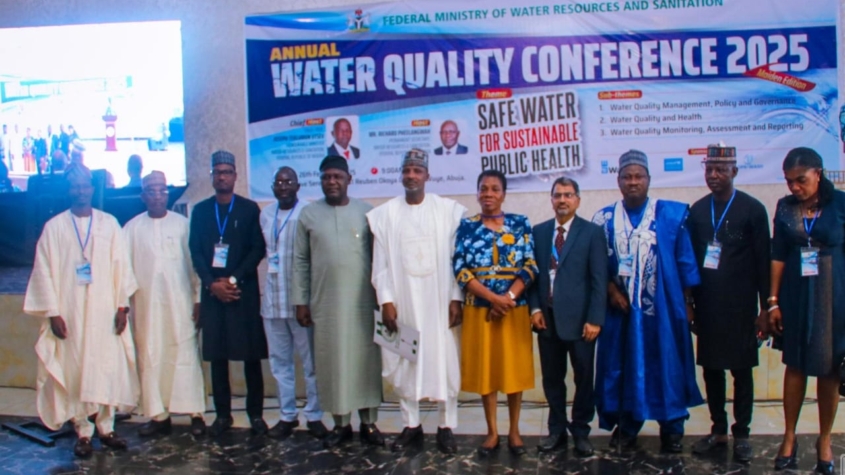
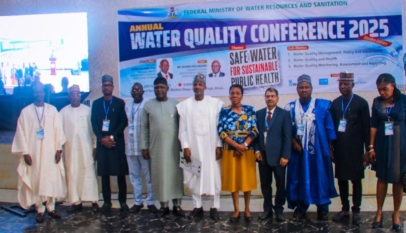
Minister of Water Resources, Prof. Joseph Utsev, disclosed on Tuesday, at the maiden edition of the Annual Water Quality Conference in Abuja, reaffirming the Ministry’s commitment to ending open defecation and improving water quality, public health, and environmental sanitation.
Represented by the Permanent Secretary, Mr. Richard Pheelangwah, the Minister highlighted the development of the Nigerian Roadmap for Water Quality Management to guide the establishment of functional National Water Quality Reference Laboratories and a Monitoring Network Programme.
Prof. Utsev emphasized that access to potable water is central to President Bola Ahmed Tinubu’s Renewed Hope agenda. He also announced the introduction of a Freshwater Restoration and Source Water Protection programme to safeguard rivers, lakes, and reservoirs.
To strengthen community involvement, the Ministry has launched the Community Water Safety Plan, empowering rural communities to detect and prevent practices that could lead to water contamination. Additionally, the Nigerian Guidelines for Rural Drinking Water Quality Monitoring and Surveillance were developed to ensure safe water from source to consumption in rural areas.
The Ministry has also begun producing Hydrogen Sulphide vials for microbial water quality testing at the community level, currently being piloted in UNICEF-supported states.
According to the 2021 Water Supply, Sanitation, and Hygiene National Outcomes Routine Monitoring Report, 67% of Nigerians have access to basic water supply services. However, only a smaller percentage enjoy safely managed drinking water. The report also shows that boreholes and tube wells serve as the primary water source for 37% of households, 11% use pipe-borne water, while 25% still rely on unsafe surface water sources, increasing the risk of waterborne diseases.
The Director of Water Quality Control and Sanitation, Mrs. Elizabeth Ugoh, said it is a collective duty to develop and implement robust policies, institutional frameworks, and innovative solutions to improve water safety across the country.
She said, “is pertinent to note that the safety of our water supplies is a public health, economic and environmental priority.
“We are all aware that contaminated water remains one of the leading causes of waterborne diseases such as cholera, typhoid, and diarrhoea, which places socio-economic development.”
In his goodwill address, Mr Chiranjibi Tiwari,
UNICEF WASH Manager, lamented that two-thirds of Nigeria’s water sources are contaminated with E. coli and Salmonella, causing severe waterborne diseases like cholera.
Tiwari, cited a 2021 WASHNORM data, reporting 111,000 cholera cases and 3,600 deaths, with outbreaks persisting, including in Lagos, a traditionally low-risk area.
He warned that contaminated water threatens public health, education and productivity, stressing the need for urgent, coordinated action to achieve SDG 6 on Universal Clean Water Access.
He also linked safe water access to President Bola Tinubu’s Renewed Hope Agenda, warning that failure to act would hinder national progress.
Tiwari called for stronger collaboration among development partners, NGOs, civil society, academia, media and the private sector.
He urged stakeholders to form structured partnerships, particularly with the private sector, to develop household water treatment technologies and public awareness campaigns to promote safer water practices.