
From Reform to Resilience: How Banks raised N4.65tn to power growth
By Abiodun Folarin

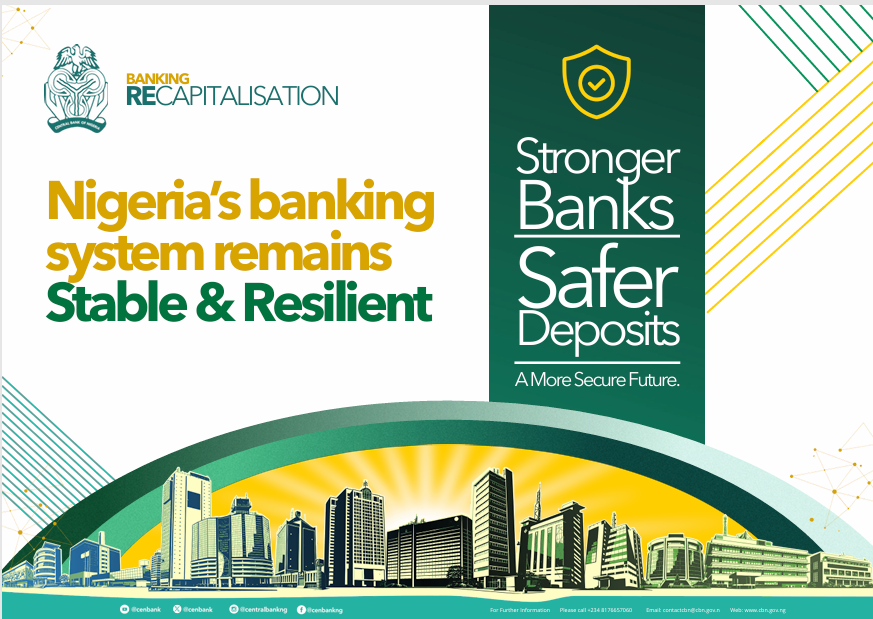
Nigeria’s banking sector has entered a new phase of strength and resilience, marking a major milestone with the successful completion of the recapitalisation programme initiated by the Central Bank of Nigeria (CBN). The exercise, which mobilized ₦4.65 trillion in fresh capital, underscores strong industry-wide compliance and sustained investor confidence.
This achievement did not occur in isolation. Rather, it stems from the CBN’s March 2024 circular, which reviewed minimum capital requirements across various banking categories. Over time, the directive evolved into what is now widely regarded as the most far-reaching banking reform since the 2005 consolidation.
By mandating higher capital thresholds, the policy aims to strengthen the resilience, competitiveness, and lending capacity of Nigeria’s financial system in an increasingly complex economic environment.
The recapitalisation exercise also reflects deeper alignment between monetary and fiscal authorities. The CBN’s decision signals coordination with the Ministry of Finance and capital market stakeholders, reinforcing a unified approach to economic management. At its core, the initiative is designed to fortify the financial system against domestic and external shocks while positioning banks to play a more active role in driving economic growth.
Beyond stability, the policy carries clear forward-looking ambitions. It aligns with the Federal Government’s goal of building a $1 trillion economy by 2030, recognising that a well-capitalised banking sector is critical for mobilising long-term financing, supporting industrial expansion, and deepening credit access across key sectors.
As CBN Governor Olayemi Cardoso noted, “The recapitalisation programme has strengthened the capital base of Nigerian banks, reinforcing the resilience of the financial system and ensuring it is well-positioned to support economic growth and withstand domestic and external shocks.”
Beyond Compliance: A Sector Ready to Scale
Under the new framework, capital requirements follow a tiered structure tailored to the scale of banking operations. Commercial banks with international licences are now required to maintain a minimum capital base of ₦500 billion. National and regional banks must meet thresholds of ₦200 billion and ₦50 billion, respectively. Merchant banks are required to hold ₦50 billion, while non-interest banks must maintain ₦20 billion for national licences and ₦10 billion for regional operations.
2026 Recapitalisation in Historical Perspective
The 2026 recapitalisation exercise inevitably draws comparisons with the landmark 2005 banking consolidation led by former CBN Governor Charles Soludo. In 2005, the apex bank raised the minimum capital requirement from ₦2 billion to ₦25 billion an aggressive reform that triggered widespread mergers and acquisitions and reduced the number of banks from 89 to 25.
By contrast, the 2026 exercise reflects a fundamentally different reality. Under Cardoso’s leadership, the reform is designed to scale an already more stable and consolidated sector, enabling Nigerian banks to finance larger transactions, compete globally, and support ambitious economic development goals.
In essence, while the 2005 consolidation represented a clean-up phase, the 2026 exercise marks a capacity expansion phase a strategic shift from survival to growth.
₦4.65 Trillion Raised as 33 Banks Meet Requirements
The apex bank confirmed that the programme, which commenced in March 2024 and concluded on March 31, 2026, attracted robust participation from both domestic and foreign investors. Notably, 72.55 per cent of the capital was sourced locally, while 27.45 per cent came from international markets an indication of sustained confidence in Nigeria’s banking industry.
The recapitalisation has also strengthened key prudential indicators, with capital adequacy ratios (CAR) across the sector remaining above global Basel benchmarks. Current minimum thresholds are set at 10 per cent for regional and national banks, and 15 per cent for institutions with international licences.
To sustain these gains, the CBN has intensified risk-based supervision, mandating banks to conduct routine stress testing and maintain adequate capital buffers under varying economic scenarios. Regulatory frameworks, it added, will continue to undergo periodic reviews to strengthen governance standards and risk management practices.
Importantly, the recapitalisation programme was executed without disruption to banking operations, ensuring seamless access to financial services for individuals and businesses throughout the transition.
Experts Applaud Exercise
Also weighing in, Professor of Capital Market, Uche Uwaleke, described the exercise as a defining moment for Nigeria’s banking industry, highlighting the high level of compliance recorded within the regulatory deadline.
He noted that the fact that 33 out of 36 banks met the March 31 requirement underscores the scale of the achievement. “By all standards, it is a huge success,” he said.
Uwaleke drew a distinction between the current exercise and the 2005 consolidation, explaining that the earlier reform was largely crisis-driven. He recalled that in 2005, many of the 89 banks were distressed, whereas the current recapitalisation reflects a more stable system where institutions raised fresh capital largely through the capital market rather than relying on forced mergers.
He further emphasised that the exclusion of retained earnings from the capital calculation makes the outcome even more remarkable. Despite these constraints, he said, banks successfully met the requirements, demonstrating strong capacity to attract new investment.
According to him, the mobilisation of over ₦4.6 trillion largely from local investors signals deepening confidence in the domestic financial system. He also noted that stronger capital buffers will enhance banks’ ability to finance large-scale projects and compete internationally.
However, he raised concerns about a persistent disconnect between the financial system and the real economy. He pointed out that while the banking sector is expanding, key sectors such as manufacturing and agriculture are not growing at the same pace.
To address this, Uwaleke urged the CBN to move beyond moral suasion and adopt more targeted policy tools, including incentives for banks that channel credit to productive sectors.
From Skepticism to Strong Capital
Also speaking, economist Adefolarin Olamilekan noted that the recapitalisation exercise was initially met with scepticism, particularly within the financial sector.
According to him, the policy was widely criticised at the outset and created uncertainty among bank customers, especially those who lacked adequate understanding of the programme. There were also fears that some banks might collapse.
He added that political commentary and global uncertainties including the impact of the Russia-Ukraine conflict further shaped negative perceptions at the time.
However, the past 24 months have demonstrated the resilience of both the CBN and the banking sector. He described the mobilisation of over ₦4.65 trillion as a significant achievement, noting that more than 73 per cent of the capital came from domestic investors largely through the stock market.
This, he said, reflects strong confidence in the Nigerian financial system.
Looking ahead, he stressed that the priority for the CBN should be effective regulatory oversight, noting that the current leadership under Cardoso has shown a clear understanding of the financial system.
A Stronger System, New Challenges
Despite the gains, recapitalisation introduces new challenges. With stronger capital bases, banks now have greater capacity to finance large-scale projects, but this also comes with higher levels of investment risk.
There is also the likelihood that banks with international licences will expand into foreign markets, making it necessary for the CBN to strengthen cross-border supervisory capacity.
Another key concern is ensuring that banks channel more credit to the real sector, particularly small and medium-sized enterprises (SMEs) and startups. As more national and regional banks emerge, both regulators and institutions face increasing pressure to improve access to credit for local businesses.
Additionally, ahead of its second-quarter 2026 Monetary Policy Committee meeting, there are discussions around a possible review of the Cash Reserve Ratio (CRR). A proposed increase from 45 per cent to 50 per cent for commercial banks, and from 16 per cent to 20 per cent for merchant banks could help strengthen liquidity control and reduce reliance on Open Market Operations and Treasury Bills.
Going Forward
The CBN’s recapitalisation programme stands out as a major success story and is widely regarded as one of the most significant reforms in Nigeria’s financial sector in recent years.
It has strengthened the resilience of the banking system, improved its ability to withstand global financial shocks, and positioned the sector to play a more impactful role in economic development.
There is growing optimism that the reform will translate into increased support for the real sector, improved access to credit, and more affordable banking services for Nigerians in the years ahead.